Crowdfunding has become one of the most effective ways to increase campaign awareness, engagement, and donations. Statistics show that the average nonprofit crowdfunding campaign brings in over $9,000!
Below, I’ll explain how to create a crowdfunding page that increases awareness of your cause and helps you bring in more donations.
How to Design a Successful Crowdfunding Page in 12 Steps
1. Decide on your goals and set a realistic timeline
Start by setting a fundraising goal that’s realistic, measurable, and aligns with your mission. Consider how an online crowdfunding campaign could help your organization.
Here are a few goals nonprofits aim to achieve through crowdfunding:
Raise money quickly for an urgent project or upcoming event
Once you’ve set a goal, decide on a timeline that aligns with your campaign objectives. Newer organizations might start with a shorter campaign, while those more familiar with crowdfunding can set timelines of six weeks or longer.
2. Choose a versatile crowdfunding platform
A solid fundraising platform is crucial to the success of your crowdfunding campaign. Opt for a crowdfunding platform like Donorbox that enables you to easily customize your crowdfunding campaign with visuals, text, and your brand colors and logo.
Here are some additional features to prioritize (more on this below):
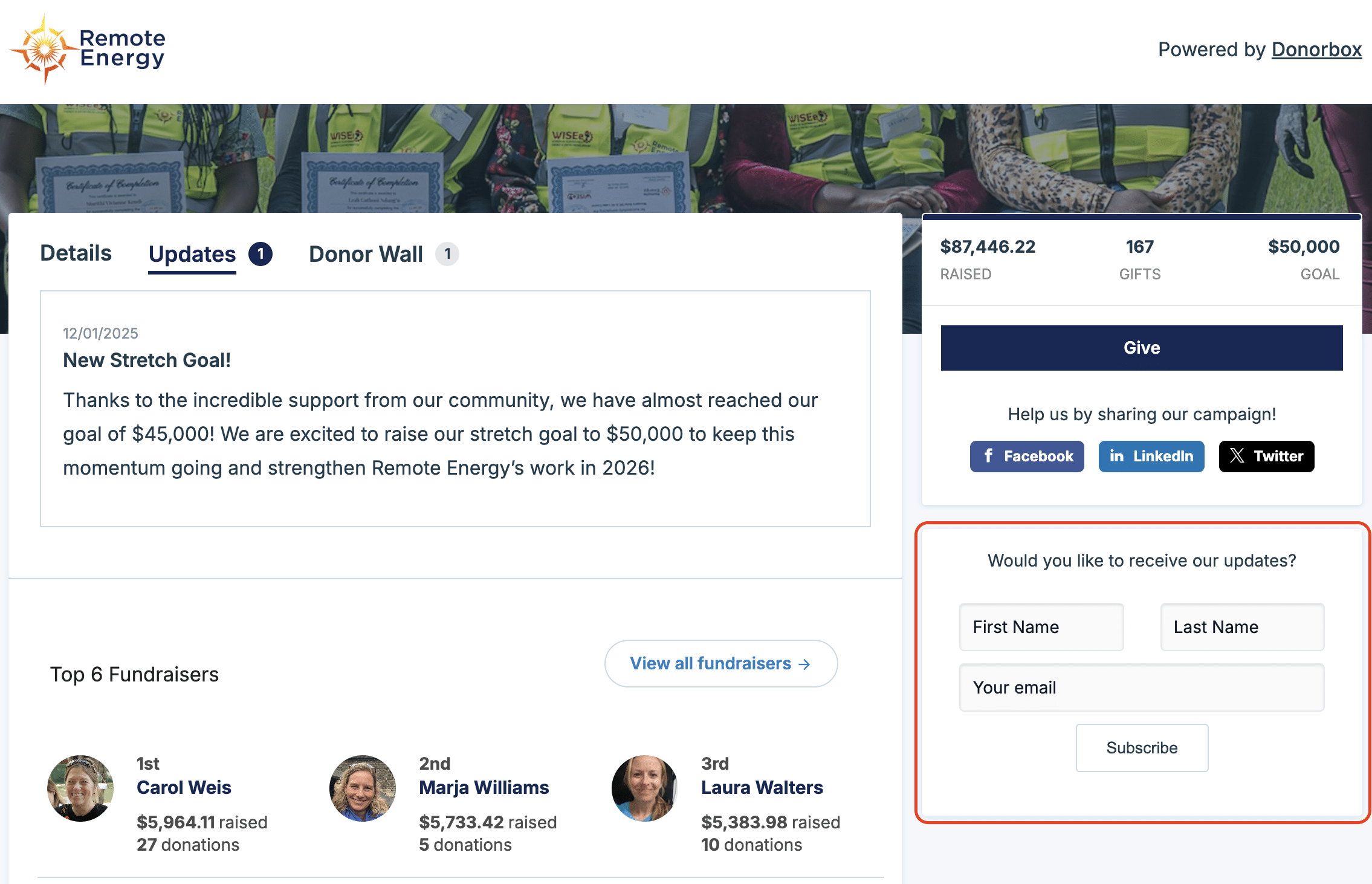
A goal meter to create a sense of urgency and inspire generosity.
Social media sharing buttons so supporters can easily share your campaign.
A dedicated space to share updates about the progress of your campaign.
The ability for supporters to subscribe to email updates.
A virtual donor wall to acknowledge donors who opt in.
See how The Surge Sanctuary uses Donorbox Crowdfunding to raise funds for their barn reconstruction project:
3. Include your fundraising goal and timeline on your page
Crowdfunding campaigns with a goal meter see an average 35% increase in giving. Publicly displaying your fundraising goal on your crowdfunding campaign helps create a sense of urgency among supporters while increasing transparency.
Use a goal meter to let supporters know how much funding you need to raise, inspiring them to possibly give a little extra so they can help you meet your goal.
Plus, include the end date of your campaign, preferably in the first paragraph of your content so it stands out and ensures additional transparency.
4. Choose a compelling title and tagline
Your title and tagline form part of your campaign’s branding and help it stand out in the crowd. Keep your title concise and direct while still explaining the goal of your campaign. Then, use your tagline to expand upon it.
Pro tip: Avoid technical terms and jargon. Ensure your title, ask, and call to action are clear, so people can easily understand and be inspired to donate.
5. Brand your campaign page
A consistent brand identity ensures a professional experience for donors while building their confidence in your organization. When creating your crowdfunding page, incorporate your organization’s logo and identity throughout to instill trust and make it easy for supporters to recognize your brand.
Ensure the following elements are consistent when branding your crowdfunding page:
Logo
Colors
Font
Mission
Language
Tone
By maintaining cohesive branding, you’ll reinforce credibility and build stronger connections with supporters.
6. Tell a story with high-quality images and videos
Strong visuals help bring your crowdfunding page to life. Include quality images and videos that tell a story to connect donors to your cause, share your impact, and motivate supporters to give.
Here are some tips to effectively leverage images and videos on your crowdfunding page:
Include authentic, high-quality visuals from your programs and initiatives to showcase the people and communities behind your mission.
Share real beneficiary stories to demonstrate the impact of donations, or tell the story about how you started your nonprofit.
Use branding elements like colors consistently to highlight key messages and ensure a polished look.
Did you know? Videos often see more engagement than written content. In fact, campaigns with personal videos raise 150% more!
Here’s an example of a crowdfunding campaign by Black Girls Code that pairs the story about the founding of the organization with an impactful video:
7. Prioritize recurring giving
Recurring giving accounted for 27% of all online revenue in 2025, underscoring its crucial role in sustainable fundraising. Recurring donations help you convert more one-time donors into long-term supporters, increase retention and the donor lifetime value, and generate a reliable income.
Ensure your crowdfunding page includes a donation form with multiple recurring donation intervals to accommodate different giving preferences. Don’t forget to highlight the impact recurring gifts can make.
Donorbox donation forms support seven recurring donation intervals. These include daily, weekly, bi-weekly, 1st and 15th, monthly, quarterly, and yearly – in addition to one-time donations. Include up to four intervals on your form, along with adjustable ask amounts.
8. Add social media sharing buttons
Ensure supporters can quickly share your campaign online by including social media sharing buttons on your crowdfunding page. This helps them spread the word among their networks and expand your campaign reach online.
9. Include a way to attract and engage potential donors
Many supporters will (hopefully) be sharing your campaign with their networks, attracting new people to your crowdfunding page.
Add a subscription option to your crowdfunding page so people can easily subscribe to email updates about your campaign – even if they haven’t donated yet. This enables you to engage them with customizable email updates.
As potential donors receive email updates and see donations being used effectively, they’ll be more likely to revisit your crowdfunding page and make a donation.
10. Update your supporters on the page itself
Being transparent about the progress of your campaign will increase your organizational credibility and inspire confidence in your brand.
Share regular updates to demonstrate campaign progress to earn the trust of your supporters, keep them engaged, and ultimately convert them into donors.
11. Add social proof to your crowdfunding page
When people see that several others have donated to your campaign, they’ll be more inclined to support your cause.
Add a virtual donor wall to your crowdfunding page to publicly acknowledge donors who opt in and inspire generosity.
12. Turn supporters into advocates through peer-to-peer fundraising
One proven way to ensure your online crowdfunding campaign is successful is to turn it into a peer-to-peer fundraising campaign.
Peer-to-peer fundraising campaigns encourage your biggest supporters to fundraise for you with their own customized fundraising pages. This enables them to share their personal connection to your cause with their own text and visuals and share it with their networks, expanding your reach and multiplying your fundraising potential.
Platforms like Donorbox let you quickly turn your crowdfunding campaign into a peer-to-peer fundraising campaign by toggling a switch. Then, encourage visitors to sign up to fundraise for you by adding an “I want to fundraise for this” button to your campaign page. You can also send personal invites to those in your network.
All funds raised through peer campaigns flow directly to your main account.
See how Summit Assistance Dogs exceeded their fundraising goal of $275,000 with Donorbox Peer-to-Peer:
Final Thoughts
A crowdfunding campaign can help your nonprofit grow your donor base and reach, elevate engagement, and raise more funds. Using a fundraising platform that allows you to crowdfund in creative ways while keeping campaign momentum going is crucial to the success of your campaign.
Donorbox, for example, provides helpful features and tools to help you raise more. More than 100,000+ organizations trust Donorbox to raise funds through its customizable donation forms, crowdfunding, peer-to-peer fundraising, and beyond.
If you haven’t already, sign up to start fundraising in minutes.
For more fundraising tips and articles, visit the Nonprofit Blog.
Kristine Ensor is a freelance writer with over a decade of experience working with local and international nonprofits. As a nonprofit professional she has specialized in fundraising, marketing, event planning, volunteer management, and board development.

 Join the fundraising movement!